A large customer sends your company a detailed ESG questionnaire covering emissions, workforce data, policies, risks and suppliers. Which information can it require, and when can your organisation decline to provide more? The VSME value chain cap creates a clearer boundary for sustainability data requests made to smaller value-chain partners.
What is the VSME value chain cap?
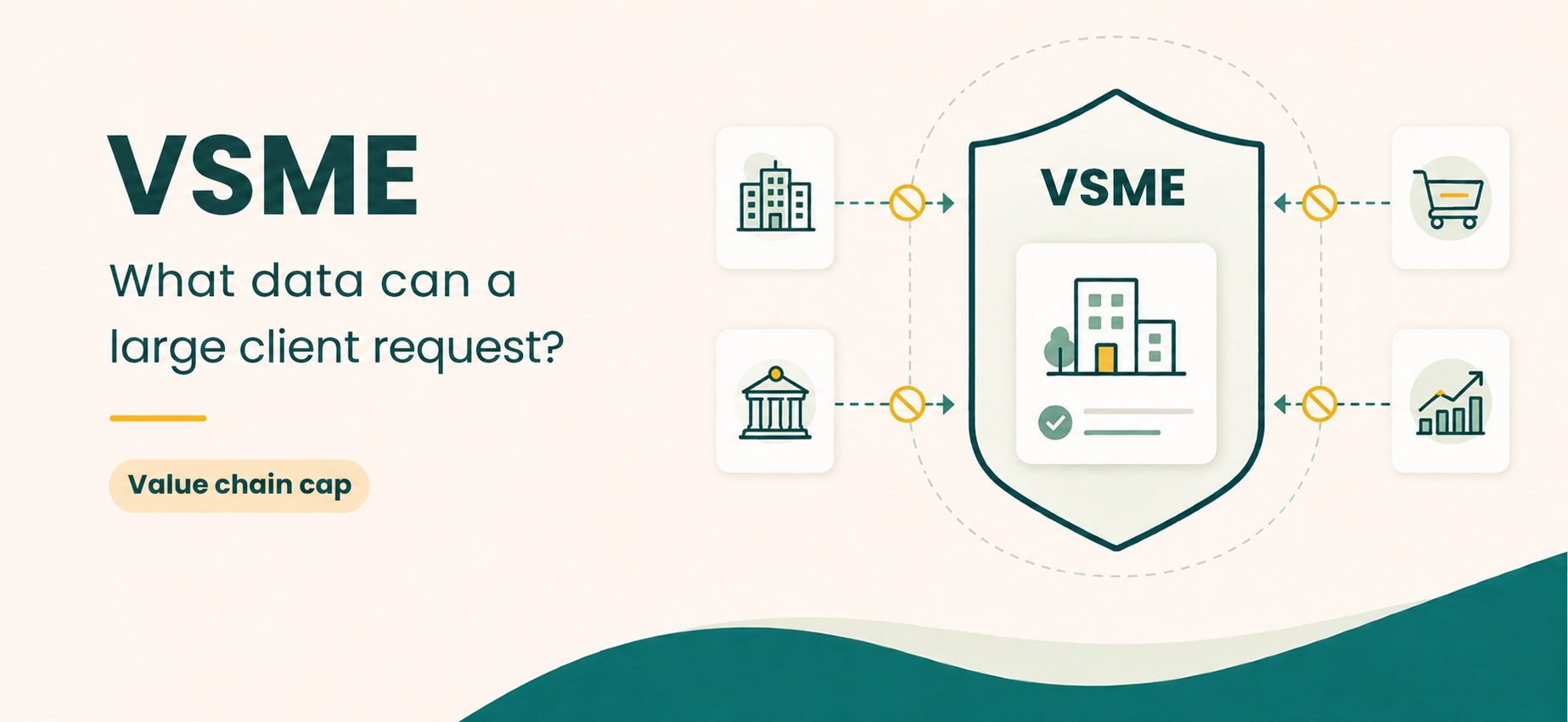
The value chain cap is a proportionality mechanism within the EU sustainability reporting framework. It limits the sustainability information that a company reporting under CSRD may require from a smaller organisation in its value chain.
The underlying logic is straightforward. Large reporting companies need information from suppliers and other business partners, but those requests should not force smaller organisations to reproduce the full complexity of mandatory ESRS reporting. The voluntary standard establishes a common reference scope for proportionate information requests.
Directive (EU) 2026/470 defines a protected undertaking as an organisation that:
A reporting company may rely on the supplier’s self-declaration regarding its protected status unless that declaration is manifestly incorrect.
What ESG data can a large customer require?
The decisive question is not simply whether a customer is large. It is why the information is being requested.
Where the request is made so that the customer can meet its mandatory sustainability reporting obligations, the customer may not require a protected undertaking to provide information beyond the voluntary standard. The exact cap is linked to the standard adopted by the European Commission.
| Type of request | Can the customer require it? | What the supplier should check |
|---|---|---|
| Information within the voluntary standard, requested for CSRD reporting | Potentially yes | Confirm the purpose, the relevant disclosure and whether the request is proportionate. |
| Information exceeding the value chain cap, requested for CSRD reporting | No, not from a protected undertaking | The supplier has a statutory right to decline the above-cap information. |
| Additional information requested voluntarily | The customer may ask, but the supplier may decline in the CSRD context | Assess whether providing it creates a commercial benefit or unnecessary burden. |
| Information required for due diligence, product compliance or another legal obligation | Possibly yes | The value chain cap may not apply because the request has a different legal purpose. |
| Information required under a commercial contract or supplier programme | Depends on the agreement and applicable law | Review the contractual basis instead of assuming that the value chain cap resolves the issue. |
When does the right to decline apply?
A protected undertaking has the right to decline information that exceeds the voluntary standard when the request is made for sustainability reporting required under the Accounting Directive.
This creates a practical distinction between three categories of data:
If the customer seeks information above the cap for CSRD reporting, it should identify which items exceed the standard and inform the supplier of its right to decline.
When does the value chain cap not automatically apply?
The protection is tied to mandatory sustainability reporting. It does not automatically prevent information requests made for other purposes.
| Situation | Value chain cap | Practical consequence |
|---|---|---|
| CSRD value-chain reporting | Applies | Above-cap information cannot be required from a protected undertaking. |
| Corporate sustainability due diligence | Does not automatically apply | The request may follow separate EU or national due-diligence rules. |
| Product-specific environmental or safety requirements | Does not automatically apply | Sector and product legislation may require additional information. |
| Bank or investor questionnaire | Not automatically | VSME remains a useful market standard, but the statutory cap may not govern the request. |
| EcoVadis or another supplier-rating process | Not automatically | The rating methodology and commercial agreement determine the requested scope. |
What role does VSME play?
VSME provides the technical foundation for a proportionate sustainability information standard for companies outside mandatory CSRD reporting. It organises common environmental, social and governance information in a format designed for business relationships with customers, banks and investors.
This article focuses specifically on the value chain cap. For the full explanation of the Basic and Comprehensive modules, the B1–B11 and C1–C9 disclosures, data sources and report-preparation process, read Envirly’s practical VSME reporting guide for SMEs.
Keeping these topics on separate pages is deliberate:
How should a supplier respond to an ESG questionnaire?
Ask why the information is needed
Confirm whether the request supports CSRD reporting, due diligence, supplier qualification, financing, risk management or a contractual requirement.
Confirm whether your company is protected
Check the employee threshold and prepare a concise self-declaration if the customer needs confirmation of your status.
Map the questionnaire to the voluntary standard
Identify which questions fall within the standard and which appear to exceed it. Avoid treating a 200-row spreadsheet as a legal authority merely because it arrived with a deadline.
Request clarification on above-cap questions
Ask the customer to identify the reporting purpose and distinguish mandatory information from additional voluntary requests.
Respond with structured data and evidence
Provide consistent figures, methodology, reporting periods and supporting documentation. A clear response is usually more effective than simply sending another spreadsheet.
Examples: can the supplier decline?
| Example request | Likely assessment |
|---|---|
| A CSRD-reporting customer requests energy use and Scope 1 and 2 emissions covered by the voluntary standard. | The information may fall within the cap and may be required for the customer’s reporting. |
| The same customer requests a detailed analysis designed for full ESRS reporting that exceeds the voluntary standard. | A protected supplier may decline the above-cap information when the request is made for CSRD reporting. |
| A manufacturer requests product-composition data required under product safety legislation. | The value chain cap may not apply because the purpose is not CSRD reporting. |
| A bank asks for sustainability information during credit assessment. | VSME may provide a useful structure, but the statutory CSRD value chain cap does not automatically govern the request. |
| A customer requests additional information voluntarily to compare suppliers. | The supplier should assess the commercial value, burden and contractual context before responding. |
Why prepare VSME data even when the cap protects you?
The right to decline excessive requests is useful, but it does not remove the need for credible sustainability information. A supplier that can respond quickly with consistent data is easier to qualify, easier to finance and less likely to rebuild the same dataset for every customer.
How Envirly supports VSME data requests
Envirly helps companies organise the operational layer behind a VSME response: data sources, responsibilities, calculations, evidence and recurring updates.
Turn ESG requests into a repeatable process
Envirly brings sustainability data, responsibilities and evidence into one structured workflow, helping your team respond efficiently and recognise when a request exceeds the appropriate scope.
Book a free ESG consultationFAQ: VSME value chain cap
Is the VSME value chain cap already part of EU law?
Directive (EU) 2026/470 establishes the protection and the right of protected undertakings to decline information above the voluntary standard in the relevant reporting context. The detailed voluntary standard is being established through a Commission delegated act, and national implementation should also be considered.
Who qualifies as a protected undertaking?
An undertaking in the value chain of a reporting company that did not exceed an average of 1,000 employees during the preceding financial year.
Can a supplier refuse the entire ESG questionnaire?
Not automatically. The right concerns information exceeding the voluntary standard when requested for mandatory sustainability reporting. Questions within the cap or based on another legal or contractual purpose require separate assessment.
Does the cap apply to EcoVadis questionnaires?
Not automatically. EcoVadis is a supplier-rating process, not mandatory CSRD reporting. VSME data may help answer the questionnaire, but the statutory value chain cap may not control its scope.
Does the supplier need a complete VSME report to rely on the cap?
No. The protection is based on the supplier’s status and the purpose of the request, not on whether it has already published a complete VSME report.
Where can I find the complete VSME disclosure checklist?
See Envirly’s separate VSME report guide, which covers the Basic and Comprehensive modules, disclosure checklist, data sources and implementation steps.
Official sources:
- Directive (EU) 2026/470
- European Commission: explanatory information on the value chain cap
- Draft delegated regulation establishing the voluntary standard
- European Commission: VSME Recommendation
Regulatory status reviewed in June 2026. This article is for general information and does not constitute legal advice.



.png)



-p-500.png)


.png)


