Clothing LCA Case Study | Envirly x Ubrania Do Oddania

This is some text inside of a div block.

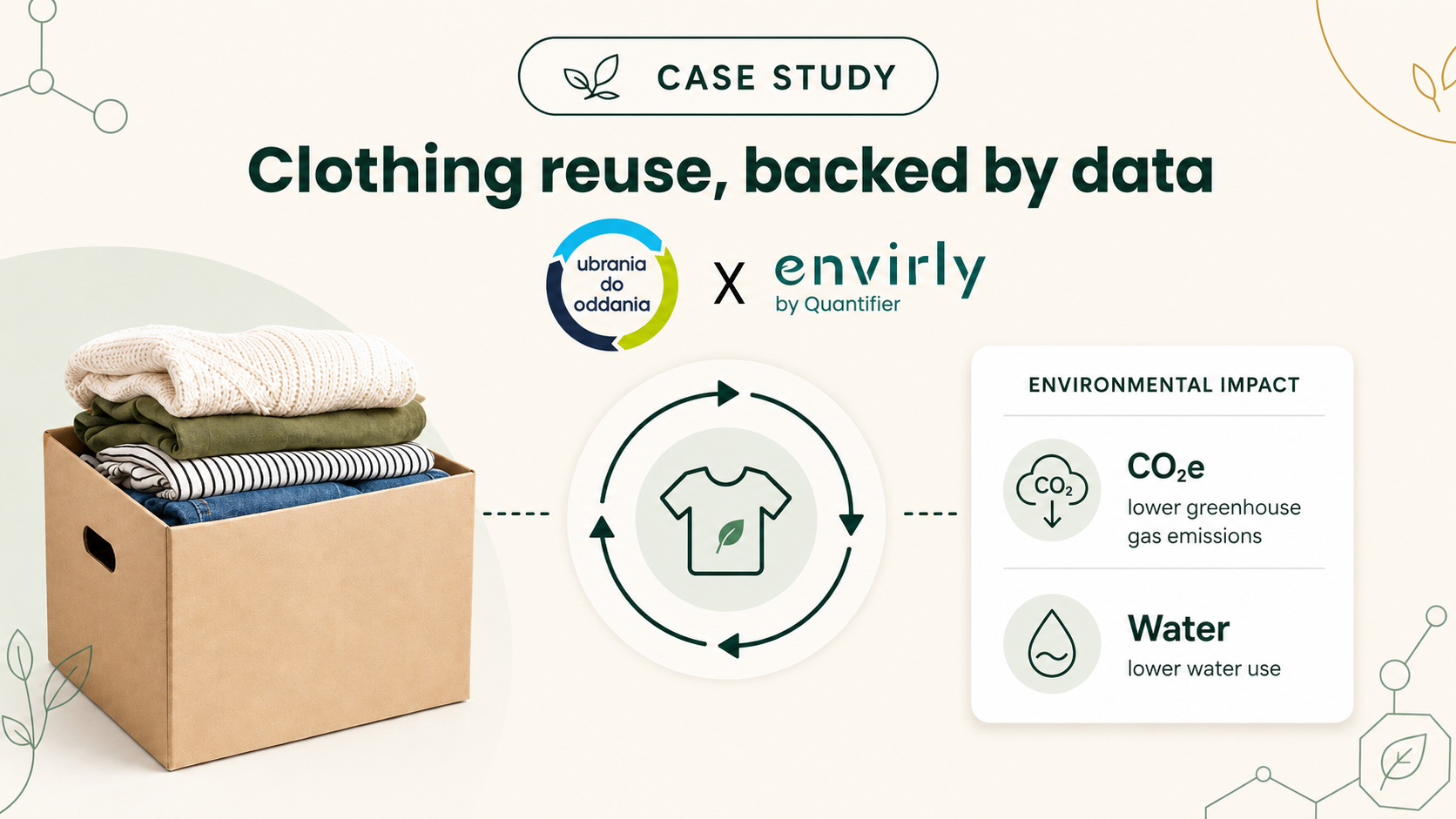
See how Envirly and Ubrania Do Oddania used LCA to update an environmental impact calculator for clothing reuse, avoided CO₂e emissions and reduced water use.

Table of contents

Case study · Circular fashion · LCA

Envirly x Ubrania Do Oddania: measuring the impact of clothing reuse

Circular fashion, backed by numbers. How Ubrania Do Oddania built an LCA-based environmental impact calculator designed to withstand greenwashing scrutiny.

Every T-shirt passed on for reuse represents a measurable amount of greenhouse gas emissions and water withdrawal that can be avoided compared with producing a new garment. The question is: how much, and how can the result be substantiated?

Ubrania Do Oddania set an ambitious goal: to show users the real impact of their decisions in a way that could withstand detailed questions about methodology. No vague claims, no marketing shortcuts and no unsupported “we estimate that…” statements. Working with Envirly, the company rebuilt its environmental impact calculator around a full LCA approach and robust data for two comparable scenarios: producing new clothing and preparing used garments for recirculation.

Context: circular fashion needs credible numbers

The Ubrania Do Oddania model is simple: people send in clothes they no longer need, support a selected social initiative and help reduce textile waste. A few clicks, one parcel and a tangible result.

In environmental communication, however, a simple user journey is only half the story. The other half is answering the question increasingly asked by informed consumers and business partners: “Show us how you calculated it.”

UDO therefore needed more than an attractive website counter. It needed current, auditable data that could translate every kilogram of donated clothing into specific, explainable outcomes: avoided greenhouse gas emissions and reduced water withdrawal.

The project followed one uncompromising principle: the calculator was not to become a decorative website feature or a marketing counter. It had to be grounded in LCA, use a clearly defined scope and compare two processes that users could intuitively understand: the environmental cost of producing new clothing and the UDO process for bringing garments back into circulation.

The challenge: communicating impact without greenwashing

In the fashion industry, environmental claims are increasingly difficult to make without supporting data. Consumers, B2B partners and ESG teams ask about methodology, system boundaries and the sources behind reported indicators. This is particularly important in reuse models, where communication often starts from the intuitive assumption that extending a garment’s life is preferable to producing a replacement. Intuition is a useful starting point, but it is not evidence.

The Ubrania Do Oddania team needed clear answers to several practical questions:

What is the environmental impact of producing 1 kg of new clothing?
What is the impact of the UDO process for 1 kg of clothing prepared for recirculation?
What difference can be credibly presented to users in the calculator?
How can technical results be translated into language that users understand?
How can the communication be based on data that can be explained to partners and companies involved in collection campaigns?

The greatest risk was an overly general narrative. An environmental claim without a precise scope quickly loses credibility. The starting point was therefore not a slogan, but a functional unit: 1 kg of clothing.

How Envirly helped

Envirly supported Ubrania Do Oddania in updating its environmental indicators and impact calculator. The work focused on comparing two scenarios: the production of new clothing and the UDO process for preparing garments for recirculation.

The scope of the engagement included:

defining the analytical objective and reference unit,
structuring the two scenarios being compared,
developing indicators for GHG emissions and water withdrawal,
applying LCA methodology and appropriate environmental data sources,
converting the results into values that could be used in the calculator,
supporting transparent communication of the results on the UDO website.

The most important outcome was a tool that allows users to see the effect of their own decision. People donating clothing can understand how much greenhouse gas emissions and water withdrawal may be avoided compared with producing new garments.
Methodology: LCA, system boundaries and data sources

The assessment was conducted using Life Cycle Assessment methodology. LCA makes it possible to evaluate the environmental impact of a product or process within a clearly defined life-cycle scope. In this project, it was used to compare the impact of producing new clothing with the impact of the processes carried out by Ubrania Do Oddania.

The functional unit was 1 kg of sampled clothing. The assessment used a cradle-to-gate boundary, ending when garments leave the sorting facility within the UDO model. This boundary enabled a consistent comparison between the production of new clothing and the preparation of used clothing for recirculation.

kg CO₂e Greenhouse gas emissions per kilogram of clothing.
m³ and litres Total water withdrawal per kilogram of clothing.

UDO’s methodology communication identifies Ecoinvent 3.11, AIB 2024, peer-reviewed research available through ScienceDirect and supplier data as the main sources used in the assessment. This means the calculator is based on datasets selected for the specific analytical purpose.

The calculator as a tool for education and partnerships

The updated environmental impact calculator serves several purposes. For users, it shows the effect of responsibly passing clothing on for reuse. For UDO’s partners, it provides data that can support ESG communication, employee engagement, social campaigns and CSR initiatives.

UDO presents the impact in technical units as well as through comparisons that are easier for a general audience to understand. Calculator outputs are translated into equivalents such as hours of online video streaming, kilometres driven by car, years of drinking water for one person and the number of five-minute showers.

These comparisons make the scale of impact easier to understand without replacing the underlying methodology. Kilograms of CO₂e and cubic metres of water are essential in technical reporting, but they do not always work in user-facing communication. The calculator connects both levels: it retains the source indicators while translating them into language that can be understood quickly.

Value for Ubrania Do Oddania

The collaboration with Envirly strengthened the company’s credibility, user education, partner communication and practical use of environmental data.

1

More credible environmental communication

LCA-based data helps UDO communicate the impact of clothing reuse in a way that is more resilient to greenwashing concerns. The company can clearly explain what was measured, for which functional unit and within which boundary.

2

A practical tool for users

The calculator provides immediate feedback. The weight of donated clothing can be linked to a specific environmental result, reinforcing users’ sense of agency and supporting awareness of more responsible consumption.

3

Stronger conversations with B2B partners

Companies involved in clothing collections or social campaigns receive indicators they can use internally and externally, without reducing communication to broad, unsupported claims.

4

A foundation for further optimisation

LCA supports communication, but it also helps identify the process elements that matter most and where further operational improvements may be possible.

What this case study shows fashion, retail and recommerce businesses

The project demonstrates a straightforward principle: environmental communication should begin with data. This is particularly relevant for companies comparing circular business models with conventional production or helping customers understand the impact of their decisions.

The key lessons are:

Start with a functional unit. In this case, the functional unit was 1 kg of clothing.
Define the system boundary clearly. The project used a cradle-to-gate boundary ending when clothing leaves the sorting facility.
Use data that can scale. This allows the calculator to update results in line with the total weight of collected clothing.
Environmental claims should follow the methodology. Without a methodological foundation, they quickly become statements that cannot be defended.
The most effective ESG tools are close to the user experience. The UDO calculator shows the impact of a specific decision to pass clothing on for reuse.

Conclusion

The collaboration between Envirly and Ubrania Do Oddania shows how environmental data can support a circular business model in practice. The updated impact calculator translates clothing donations into specific indicators: avoided CO₂e emissions and reduced water withdrawal compared with producing new textiles.

Using LCA, Ubrania Do Oddania can communicate the impact of clothing reuse in numbers, while users and partners gain a clearer understanding of the results of their actions. This is a practical example of environmental data being used beyond formal reporting: in education, communication, partnerships and business model development.

The lesson for fashion, retail and recommerce companies is clear. Before communicating environmental impact, they need to define exactly what was measured, which system boundary was used and which data sources support the result. Only then does the communication rest on a credible foundation.

Would you like to measure the environmental impact of a product, service or process?

Envirly helps companies conduct LCA studies, calculate carbon footprints, prepare ESG data and turn results into practical communication tools for customers, partners and financial institutions.

Book a consultation with Envirly experts

You may also be interested in

Clothing LCA Case Study | Envirly x Ubrania Do Oddania

See how Envirly and Ubrania Do Oddania used LCA to update an environmental impact calculator for clothing reuse, avoided CO₂e emissions and reduced water use.

Read more
VSME Value Chain Cap: What ESG Data Can Customers Request?

Learn how the VSME value chain cap limits ESG data requests from large customers, who is protected, when the right to decline applies, and how suppliers should respond.

Read more
EPD: What Is an Environmental Product Declaration and How to Get One? | Envirly

A practical guide to EPD: what it is, who needs it, how the process works, and how Envirly LCA supports product-level environmental data preparation.

Read more
LCA Use Cases: 5 Ways Envirly LCA Supports Business

Explore five practical LCA use cases showing how Envirly LCA helps companies calculate product carbon footprints, scale LCA across SKUs and respond to Scope 3 requests.

Read more
How to Collect ESG Data in Your Company: A Practical Guide

Learn how to organise ESG data collection across your company, from data source mapping and ownership to automation, validation, audit trail and CSRD/ESRS reporting.

Read more
VSME Report: A Practical Guide to Voluntary ESG Reporting for SMEs in 2026

Learn how to prepare a VSME report, what to disclose under the Basic and Comprehensive modules, and how SMEs can use it with clients, banks and supply chains.

Read more
Digital Product Passport: Complete Guide for Manufacturers 2025–2026

A practical guide to the Digital Product Passport under ESPR: timelines, required product data, LCA, ISO 14067, GS1 identifiers, EPD links and compliance steps.

Read more
Ecovadis
EcoVadis Rating: How to prepare your company for ESG assessment.

EcoVadis is a system for assessing companies in the area of ESG.

Read the article
Cybersecurity
Ransomware attack on a Polish manufacturing company

Ransomware attack on a Polish manufacturing company: business impact and lessons for security and ESG

Read the article
ESG reporting
SBTi and ESRS - act before it’s too late

ESG (Environmental, Social, Governance) is becoming increasingly popular among Polish companies.

Read the article
CBAM
Carbon Footprint and Your Company: A Compact Knowledge Base

Carbon footprint assessment is complex and still unfamiliar to many.

Read more
Quantifier.ai
Quantifier.ai: ushering in a new era of compliance

The future of compliance starts now. Envirly is introducing Quantifier, an autonomous AI powered solution.

Read the article
Omnibus
Omnibus Directive - changes in ESG regulations

Omnibus, CSRD, ESRS, CSDDD, CBAM, the EU Taxonomy: in this article we examine the package of changes to ESG regulation.

Read the article

Contact us and find out more