EPD and LCA
EPD: what is an Environmental Product Declaration and how do you get one?
A practical guide for manufacturers that need credible product environmental data for tenders, green building certification, B2B sales, Digital Product Passports and ESG reporting.
A construction customer asks for an EPD. A public tender requires an environmental declaration. A retail chain wants LCA-based documentation to evaluate suppliers. More and more B2B buyers, from real estate investors to global retailers, treat EPDs as a practical requirement in product qualification.
An EPD, or Environmental Product Declaration, is one of the most widely recognised formats for communicating product environmental data in B2B markets. It is based on Life Cycle Assessment, follows product category rules and is independently verified before publication.
This guide explains what an EPD is, who typically requires it, how the EPD process works step by step, what it may cost and how Envirly LCA helps structure the product data required for an LCA-based EPD process.
What is an EPD?
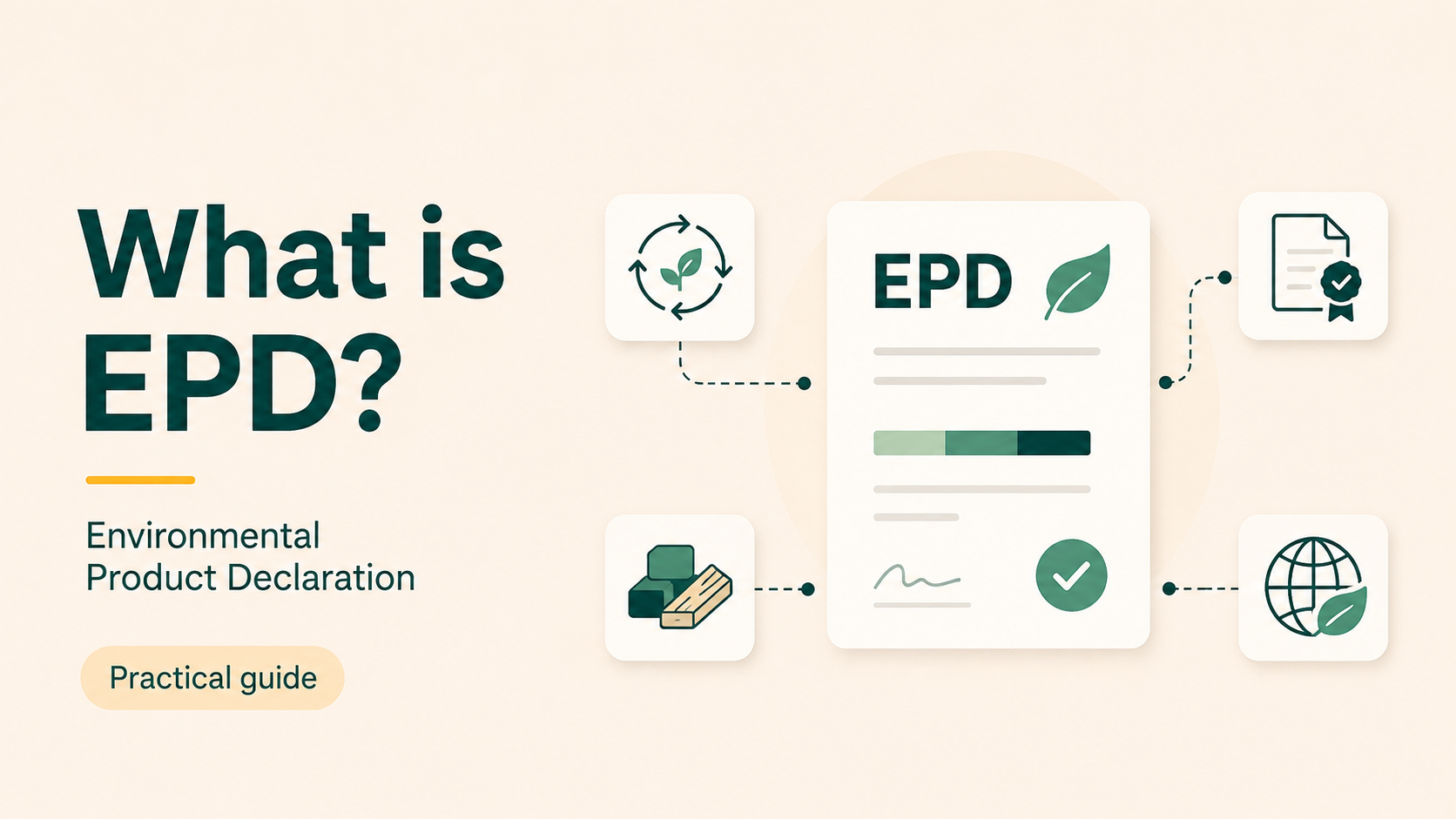
An EPD, or Environmental Product Declaration, is a verified document that presents the environmental impact of a product based on Life Cycle Assessment. It is usually prepared in line with ISO 14025 and the relevant Product Category Rules, often referred to as PCRs.
The key point is that an EPD does not say that a product is “good” or “bad” for the environment. It is not an eco-label and it is not a simple badge placed on packaging. An EPD presents data: emissions, resource use, acidification potential, eutrophication potential, energy consumption and other impact categories required for a given product category.
What does an EPD usually include?
Who requires an EPD and when does it make sense to prepare one?
In formal terms, EPDs are voluntary in many contexts. In practice, they are increasingly used as a tender requirement, a sales argument or a documentation standard requested by B2B customers. This is especially relevant for companies selling products into sectors with high regulatory or procurement pressure.
Construction and public procurement
Construction is one of the most important markets for EPDs. Environmental Product Declarations are used in green building certification schemes such as LEED, BREEAM and DGNB, as well as in public procurement and projects where investors expect measurable environmental data for materials.
B2B supply chains
Large customers increasingly request product-level environmental data from suppliers. An EPD can support supplier qualification, procurement documentation and customer conversations where evidence matters more than broad sustainability statements.
Digital Product Passports
An EPD is not the same as a Digital Product Passport. However, it can provide highly valuable environmental data for a DPP. If a company already has a robust LCA model and EPD, part of that environmental data can be reused in a Digital Product Passport structure.
ESG and CSRD reporting
EPDs help structure product-level environmental data. For customers subject to ESG and CSRD reporting, an EPD can support Scope 3 calculations, especially for purchased goods and services.
The EPD process step by step
Preparing an EPD involves several stages: choosing the right programme, preparing the data, building the LCA model, completing independent verification and publishing the declaration. It is not just an LCA consultant’s task. It requires data from production, procurement, logistics, quality, technical teams and often suppliers.
Choose the EPD programme and the relevant PCR
An EPD programme manages the rules for verification and registration. The PCR defines which methodology applies to a given product category, which life cycle stages must be included and which indicators must be reported.
Collect input data for the LCA
The required data typically includes product composition, material weights, energy, water, waste, transport, packaging, use-phase assumptions and end-of-life scenarios.
Build the LCA model and calculate results
Based on the input data, an LCA model is created and the required environmental impact categories are calculated. For construction products, modules aligned with EN 15804 are often central to the analysis.
Complete independent verification
An EPD must be verified by an independent expert accepted by the relevant EPD programme. The verifier reviews compliance with the PCR, methodological correctness and completeness of the documentation.
Register and publish the EPD
After successful verification, the EPD is registered and published in the programme’s public database. The declaration is usually valid for a defined period and must be updated when the product, process or data changes materially.
How much does an EPD cost?
The cost of an EPD depends on product complexity, the number of variants, data quality, the selected EPD programme, the required LCA scope and verifier workload. The values below should be treated as indicative market ranges, not as a fixed price list.
| Cost component | Typical range | What drives the cost? |
|---|---|---|
| LCA preparation | from several to several dozen thousand PLN or EUR equivalent | Product complexity, number of materials, data availability, number of SKUs and scenario modelling requirements. |
| EPD verification | from several to over ten thousand PLN or EUR equivalent | EPD programme, declaration scope, verifier workload and the number of review rounds. |
| Programme registration | usually a programme fee | Selected programme operator, number of declarations, target market and product category. |
| LCA data and databases | depends on the operating model | Access to databases such as ecoinvent, quality of primary data and the need to purchase additional datasets. |
| Update after several years | usually lower than the first EPD | Extent of changes in the product, process, energy mix, suppliers and input data. |
PCR: why product category rules matter
PCRs, or Product Category Rules, define how an LCA and EPD should be prepared for a specific product category. They determine the declared or functional unit, required life cycle stages, data requirements and how the results should be interpreted.
| Standard or PCR | Typical use | Practical relevance |
|---|---|---|
| EN 15804 | Construction products in Europe | A key reference point for construction EPDs, especially for life cycle modules A1-D. |
| ISO 21930 | Construction products in global markets | Helps prepare declarations accepted in projects outside the EU. |
| EPD programme PCRs | Specific product categories | Supplement general standards with category-specific requirements. |
| PEFCR | Selected consumer product categories | Rules connected with the EU Product Environmental Footprint methodology. |
EPD vs DPP: what is the difference?
EPDs and Digital Product Passports often appear in the same conversation, but they serve different purposes. An EPD is a verified environmental declaration, usually published as a document in an EPD programme database. A DPP is a digital product record that may include environmental, material, technical, identification and regulatory data.
| Criterion | EPD | DPP |
|---|---|---|
| Nature | Verified environmental declaration. | Digital product record accessible, for example, through a QR code or API. |
| Scope | LCA results aligned with PCR requirements. | Environmental, material, technical and identification data. |
| Access | Usually a public declaration in an EPD programme database. | Digital access, potentially with different permission levels. |
| Updates | Periodic, typically after several years or after a material change. | Potentially dynamic, depending on the system architecture. |
| Common ground | LCA data can feed a DPP. | A DPP can link to an EPD or use the same environmental data foundation. |
EPD vs PCF: which one do you need?
A PCF, or Product Carbon Footprint, focuses on one impact category: climate change, expressed in kg CO2e. An EPD presents a broader environmental profile of the product in line with PCR requirements. This makes PCF a useful first step in many cases, but not sufficient where a customer, tender or certification scheme requires a full EPD.
| Criterion | EPD | PCF |
|---|---|---|
| Environmental scope | Multiple impact categories defined by PCR. | One category: greenhouse gas emissions. |
| Typical use | Construction, tenders, green building certification and supplier qualification. | Scope 3 data, B2B communication and fast product carbon footprint assessment. |
| Time and cost | Usually higher because verification and registration are involved. | Usually lower, especially for simple products with well-prepared data. |
| Verification | Required by the EPD programme. | Depends on the intended use and customer or regulatory requirements. |
How Envirly LCA accelerates EPD data preparation
The most time-consuming part of preparing an EPD is often the input data and the LCA model. Envirly LCA helps move this process from scattered spreadsheets and manual work into one structured environment.
Data import through Excel, CSV and product identifiers
Instead of manually retyping bills of materials, teams can import product data and build the foundation of the LCA model faster.
Access to ecoinvent data
The platform supports mapping materials and processes to recognised LCA datasets, improving consistency and credibility of the calculations.
Life cycle model structure and missing-data control
The model structure helps identify missing inputs, process stages and assumptions that must be completed before verification.
Reuse of models across product variants
If a company has several similar products, a base model can be reused for future variants by changing only the key parameters.
FAQ: common questions about EPDs
Q How is an EPD different from an eco-label?
An EPD does not claim that a product is “green” or “better”. It presents verified environmental data based on LCA. An eco-label often confirms that a product meets defined criteria, while an EPD primarily provides standardised data.
Q Does every company need an EPD?
No. EPDs are not a universal legal requirement for all companies. In practice, they are often requested by customers, tenders, building certification schemes or supplier qualification processes.
Q How long does it take to prepare an EPD?
It depends on data quality, product complexity, the selected programme and verifier availability. In practice, companies should think in months rather than days. Collecting and structuring input data is often the longest stage.
Q Can EPD data be used in a Digital Product Passport?
Yes. Data prepared for an EPD can be a valuable input for a Digital Product Passport. However, an EPD and a DPP are not the same thing. A DPP is digital by design and may include a wider range of product data.
Q Does Envirly LCA replace the EPD verifier?
No. Envirly LCA supports data preparation and LCA modelling, while formal EPD verification and programme registration remain separate steps.
Q When should a company start with PCF and when should it prepare an EPD?
PCF is a strong starting point when a customer mainly needs CO2e emissions data. EPD is the right choice when a full, verified environmental profile is required, especially in construction, tenders and certification processes.
Prepare LCA data for EPD with Envirly
Envirly LCA helps structure product data, build an LCA model, work with ecoinvent data and create a solid foundation for EPD, DPP and B2B environmental communication.
Book a free consultation



.png)



-p-500.png)


.png)


