Introduction: why LCA is no longer reserved for laboratories
Until recently, Life Cycle Assessment, or LCA, was mainly associated with large corporations, specialist software, consulting budgets and multi-month project timelines. For many small and medium-sized companies, calculating the environmental impact of a product meant high costs, long waiting times and a methodology that felt difficult to access.
That market has changed fundamentally. EU regulations such as ESPR, CSRD, the Green Claims Directive and CBAM are creating direct or indirect demand for product-level environmental data. Not as a one-off research project, but as an operational part of business.
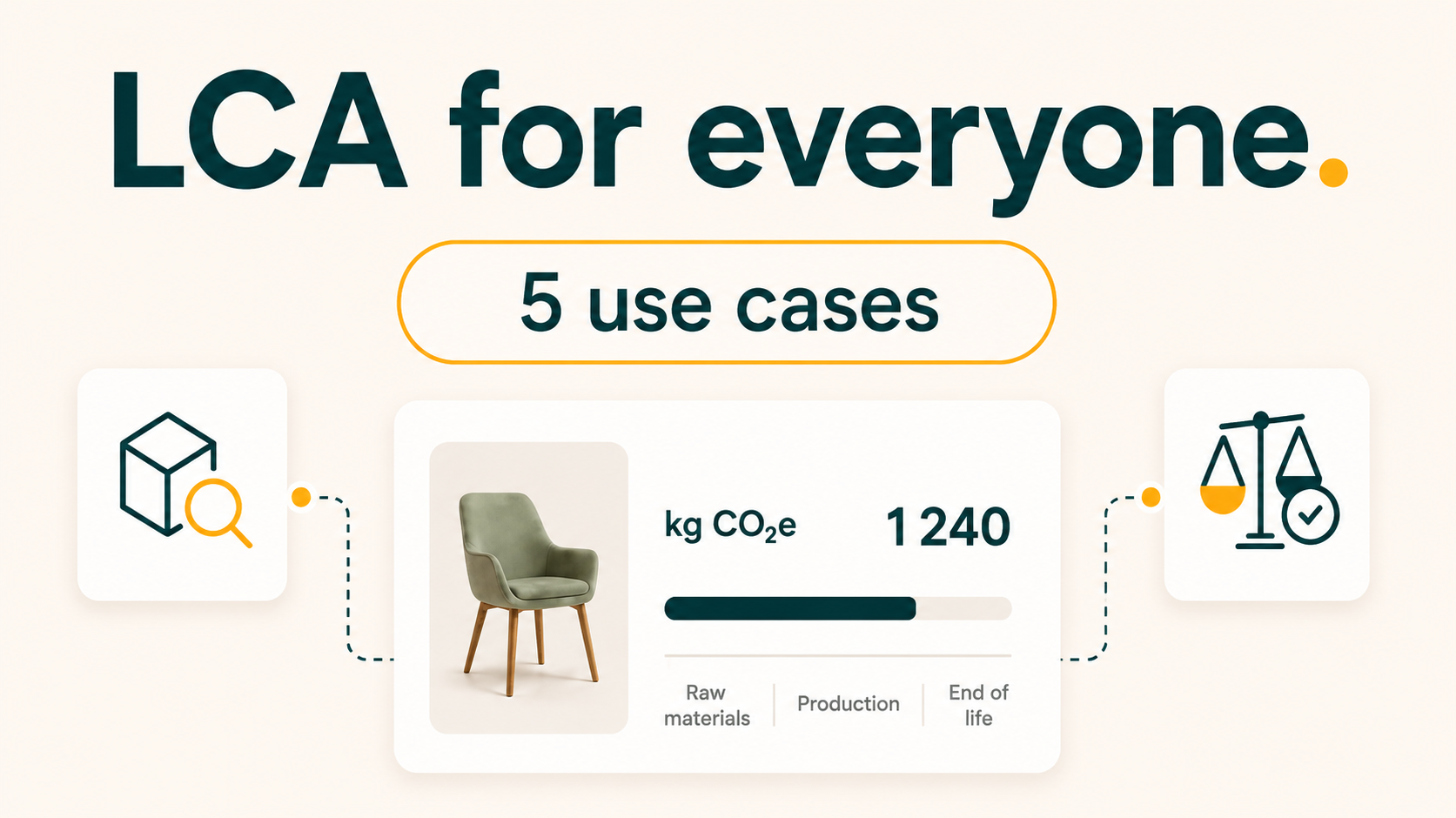
In this article, we show five specific scenarios where Envirly LCA helps solve real business problems: faster, more cost-effectively and in a way that is easier to verify than the traditional consulting approach. Each scenario is described through the lens of the problem, the mechanism, practical numbers and implementation steps.
USE CASE 01
One physical product
Speed-to-compliance: one day instead of several weeks
Context and problem
A manufacturer of a 500 ml cleaning product in the FMCG market receives a request from a retail chain: “We need the carbon footprint of your product for our Scope 3 reporting. You have two weeks.” The manufacturer has no previous LCA experience. The team does not use specialist LCA software and is not familiar with ISO 14067.
The traditional path would usually mean contacting a consulting company, waiting for a quote, signing an agreement and then waiting several weeks for the report. The result: missed deadlines, an unhappy customer and no product data ready for the next tender.
With Envirly LCA, the path is different: from an empty model to a ready product carbon footprint report within one working day, provided the necessary input data is available.
The mechanism: what makes it possible?
Speed-to-compliance in Envirly LCA is based on three foundations that remove many of the time-consuming steps of a traditional LCA process:
GS1-based product identification
Where product identifiers such as GTIN/EAN are available, product data can be structured more efficiently. This reduces manual entry, improves consistency and lowers the risk of errors in basic product information.
Built-in emission factor and LCA data support
Instead of building the entire data infrastructure from scratch, users can map materials, packaging and processes to relevant datasets and emission factors directly inside the platform.
Predefined methodological structure
By selecting a framework such as ISO 14067, the user can define the functional unit, system boundaries, calculation logic and report structure without rebuilding the methodology manually each time.
Step by step: from zero to a PCF report
Below is an example workflow for a simple FMCG product, such as a 500 ml cleaning product, using Envirly LCA:
| Step | Action | Time |
|---|---|---|
| 1 | Select the framework: ISO 14067, cradle-to-gate, functional unit = one 500 ml bottle | 5 min |
| 2 | Enter or import product identification data | 2 min |
| 3 | Add the bill of materials: ingredients, water, PET bottle, cap and label | 20 min |
| 4 | Map materials to relevant datasets and emission factors | 15 min |
| 5 | Add process inputs: production energy and transport assumptions | 20 min |
| 6 | Generate a PCF report and customer-ready summary | 3 min |
| Total | From an empty model to a structured ISO 14067-based PCF output | Approx. 65 min |
Result: what does the customer receive?
“We received a carbon footprint request on Friday. By Monday, we had a ready report. Previously, this type of project took us months and cost several times more.”
USE CASE 02
Dozens or hundreds of SKUs
Scale without linear cost growth
Context and problem
A furniture manufacturer has 300 products in its catalogue: beds, sofas, tables, chairs and wardrobes in different materials, sizes and variants. A retail customer starts asking for EPD or Digital Product Passport-related data for all supplied products.
The traditional approach is simple but brutal: every SKU becomes a separate consulting assignment. For a large catalogue, this quickly becomes financially and operationally unrealistic.
The Envirly LCA strategy is based on model reuse, cloning and Excel imports. The customer does not buy “300 separate LCA projects”. The customer builds one model for a product category and reuses it across variants.
The mechanism: model cloning and Excel imports
The key advantage of a platform approach for large product catalogues is the ability to build a hierarchy of LCA models and reuse them across many variants:
| Mechanism | How it works and what it eliminates |
|---|---|
| Model cloning | Create a base model for a product category, such as an upholstered sofa. Clone it and change only variable parameters: fabric weight, foam type, transport distance or packaging. |
| BOM import via Excel or CSV | If the material list already exists in Excel, upload the file. The platform maps columns such as material, weight, unit and supplier into the data structure. |
| Batch report generation | After base models and variants are prepared, reports can be generated for multiple SKUs without rebuilding the entire structure each time. |
| Structured product identifiers | If products use GTIN/EAN codes, identification data can be managed more consistently across the catalogue. |
Economics of scale: cost comparison
Below is an illustrative comparison of effort and economics for preparing PCF or DPP-related product data using a traditional product-by-product approach versus a platform approach:
| Number of SKUs | Traditional approach | Envirly LCA | Main benefit |
|---|---|---|---|
| 1 SKU | Separate consulting project | Subscription + internal workflow | Lower entry barrier |
| 10 similar SKUs | Multiple repeated assessments | Base model + variants | Less repetitive work |
| 50 SKUs | High consulting dependency | Category models + imports | Scalable structure |
| 300 SKUs | Operationally difficult to scale | Reusable models + batch processing | Catalogue-level readiness |
The fundamental difference is economic. A platform model allows the marginal effort per additional SKU to decrease once the initial structures are built.
Case example: building materials manufacturer
A building materials manufacturer needed environmental data for more than 100 product variants as part of a qualification process for a public procurement programme.
“If we had followed the traditional path, it would have taken years and cost roughly as much as a new production line. Envirly helped us do it for a fraction of that.”
USE CASE 03
Variable composition and transport
Scenario analysis instead of a single static number
Context and problem
A producer of an industrial detergent changes surfactant suppliers depending on availability and price. The material composition may vary between batches. Transport to customers may take place by road in standard conditions, but by air during seasonal peaks. Products may also be stored in countries with different electricity mixes.
The problem with a traditional LCA is that it often produces one static result, for example 691 kg CO2e per tonne. That number is valid only until the supplier, transport route, production mix or material assumption changes.
For the company, this creates a communication risk. It is difficult to honestly communicate one exact figure if the real footprint changes depending on operational variables. A single point without context can quickly become misleading.
The mechanism: scenario analysis in Envirly LCA
Envirly LCA helps companies model variability by comparing different scenarios instead of relying on one static model.
1. Scenario analysis: modelling variants
Instead of one product model and one result, the company can create multiple scenarios and compare them:
The platform calculates the product carbon footprint for each scenario and allows the organisation to compare the results. This supports better procurement, logistics and product design decisions.
2. Uncertainty-aware modelling
Where input data varies or contains uncertainty, the company can work with ranges rather than pretending that one number tells the whole story.
| Parameter | Traditional LCA | Envirly LCA with variability modelling |
|---|---|---|
| PCF result | One static result | Result by scenario or range |
| Uncertainty | Often not visible | Documented assumptions and ranges |
| Main drivers | May remain unclear | Material, energy and transport drivers can be compared |
| Position in verification | More difficult to explain | Better documented and more transparent |
| Decision support | Limited | Supports supplier and logistics optimisation |
Why a range is more professional than a point
Saying “691 kg CO2e” sounds precise, but it may be misleading. Every LCA contains uncertainty caused by supplier data quality, emission factors, material composition, batch variation, transport routes and energy mixes.
A scenario-based approach shows that the company understands this variability and manages it transparently.
Practical example: supplier portfolio optimisation
A chemical company with several key raw material suppliers wanted to understand which supplier choice had the greatest impact on the product footprint. In Envirly LCA, the company could build one base model, create supplier scenarios and compare the results.
The analysis showed that switching one key surfactant supplier could significantly reduce the PCF of the product. This became a practical purchasing insight, not only a sustainability metric.
“Saying ‘691 ±8%’ instead of ‘691’ is not a weaker claim. It is stronger because it is transparent and methodologically justified.”
USE CASE 04
Services and SaaS
LCA for campaigns, code and logistics where there is no factory
Context and problem
A media agency running an outdoor advertising campaign wants to estimate the campaign’s carbon footprint for a major consumer brand. An IT company providing software development services receives a questionnaire from a corporate client asking for the carbon footprint of the services delivered. A logistics operator wants to offer customers an environmental certificate for transport services expressed per tonne-kilometre.
The common problem is simple: LCA is still often associated with factories and physical products. Yet services also consume energy, materials, infrastructure and transport.
How Envirly LCA handles intangible services
Intangible services still have tangible inputs. Instead of kilograms of steel, we may have kilowatt-hours used by servers, kilometres travelled by employees, cloud infrastructure, printed materials, office space or fuel consumption.
LCA methodology can be applied to services if the functional unit is properly defined. Envirly LCA supports this through flexible framework configuration.
Scenario A: media agency — LCA of an outdoor campaign
The functional unit may be one campaign: for example 100 advertising surfaces, four weeks, one city.
The result is a campaign carbon footprint report broken down by life cycle stage and ready to share with the client as Scope 3 Category 1 documentation.
Scenario B: IT company — carbon footprint of software services
If IT services are delivered to B2B clients subject to CSRD, those clients may need Scope 3 Category 1 data from their IT suppliers. Companies that can provide a productised carbon footprint for their service gain an advantage in tenders and supplier qualification processes.
The functional unit may be one man-hour of software development, one sprint, one application module or one year of service delivery. Main emission categories include electricity, servers, laptops, office operations, employee commuting, cloud infrastructure and business travel.
Scenario C: logistics operator — PCF of a transport service
For logistics, emissions can be expressed in kg CO2e per tonne-kilometre. The necessary data is usually available: fuel consumption, distance, load factor, vehicle type and warehouse energy.
The result can be used as a customer-facing environmental certificate for a specific transport service, route or vehicle category.
Barriers and how Envirly LCA helps overcome them
| Barrier | Solution in Envirly LCA |
|---|---|
| “LCA is not for us. We do not have a factory.” | Flexible framework configuration. The functional unit can be a campaign, sprint, tonne-kilometre or man-hour. |
| “We do not have a material bill of materials.” | For services, the equivalent inputs may be energy use, fleet data, office space, cloud infrastructure and supplier invoices. |
| “Our clients will not understand the result.” | A clear one-pager translates technical results into business language: CO2e per campaign, man-hour, shipment or service unit. |
| “We do not have a consulting budget.” | A SaaS platform model allows companies to repeat and scale calculations without commissioning every service footprint as a separate project. |
USE CASE 05
B2B supplier
How to answer Scope 3 requests before competitors do
Context: the ripple effect in B2B supply chains
Large companies increasingly need environmental data from their suppliers. A logistics group, bank, retailer or industrial corporation may be required to report Scope 3 emissions. To do that, it needs better data from suppliers of goods and services.
What happens next is predictable. The corporation sends questionnaires to suppliers. Suppliers send questions to their own suppliers. Banks ask corporate clients for environmental data. Corporate clients ask their value chains. The demand travels downstream.
This is one of the strongest distribution mechanisms in ESG: suppliers are asked for data tied to contracts, tenders and qualification processes.
The mechanism of the ripple effect
The ripple effect has several layers. Each layer creates new demand for product or service footprint data:
| Level | Entity | What happens? |
|---|---|---|
| 1 | Bank or fund | Financial institutions need environmental data from corporate clients to manage and report climate-related exposure. |
| 2 | Corporation | Companies subject to CSRD need Scope 3 Category 1 data for purchased goods and services. |
| 3 | SME supplier | The supplier receives a questionnaire and needs to provide specific product or service environmental data. |
Why this use case spreads so quickly
In a traditional SaaS model, a company needs to reach every customer directly. In B2B supply chains, a large customer can create demand among hundreds or thousands of suppliers simply by asking for structured environmental data.
Each new corporate client, bank or logistics operator can create additional demand among suppliers that need to respond quickly and credibly.
What does a B2B supplier need to prepare?
A large customer may ask for the following information:
Without a specific PCF, suppliers often have to rely on generic industry averages. These are less accurate, do not create competitive advantage and may increasingly be considered insufficient by large customers.
The advantage of suppliers with PCF data
| Scenario | Supplier without PCF | Supplier with PCF data |
|---|---|---|
| Scope 3 questionnaire from a corporate customer | Provides generic averages or incomplete estimates. Risk: lower supplier score or weaker qualification. | Responds with specific data, methodology, date and supporting documentation. |
| Tender with environmental criteria | Struggles to meet the requirement or provides weak evidence. | Provides a PCF report and customer-ready summary. |
| Price negotiations | Cannot credibly use environmental performance as a commercial argument. | Can show how a lower footprint supports the customer’s Scope 3 reduction goals. |
| Retailer qualification | May fail environmental data requirements. | Provides structured documentation and opens access to new sales channels. |
How quickly can a supplier prepare PCF data?
Collect basic product data
Prepare the bill of materials, production energy data, supplier routes, transport assumptions and packaging information. If exact data is not available, start with the best available estimates and improve quality over time.
Select the framework and system boundary
For many B2B customer requests, cradle-to-gate is a practical starting point because it supports Scope 3 Category 1 reporting for the buyer.
Use structured product identification where possible
If the product has a GTIN or another identifier, use it to structure basic product information and reduce manual entry.
Complete the model and generate the report
The platform supports data mapping, highlights missing inputs and helps generate a PCF report, one-pager and, where relevant, DPP-ready data.
“A year ago, we did not know what PCF meant. Today, we have product footprint data for our portfolio and use it as a sales argument with large customers.”
Summary: which use case applies to your company?
Each of the five scenarios described in this article represents a different company profile and a different type of value delivered by Envirly LCA. Here is the short version:
| Use case | Company profile | Main challenge | Envirly LCA value |
|---|---|---|---|
| UC 01 | Manufacturer of one physical product | Urgent PCF or DPP request | Fast entry point and customer-ready product footprint data |
| UC 02 | Manufacturer with a large catalogue | Scaling without linear cost growth | Model cloning, Excel imports and reusable structures |
| UC 03 | Manufacturer with variable composition or transport | One PCF number becomes outdated quickly | Scenario analysis and uncertainty-aware modelling |
| UC 04 | Agency, IT company or logistics operator | LCA seems designed for factories, not services | Flexible functional units for campaigns, sprints and tonne-kilometres |
| UC 05 | B2B supplier to large corporations or banks | Scope 3 questionnaire from a major customer | PCF data, stronger supplier qualification and sales advantage |
FAQ: common questions about LCA use cases
Q How quickly can I prepare the first PCF in Envirly LCA?
For a simple FMCG product or one priority SKU, the process can be completed quickly if the input data is available. For more complex industrial products or services, the timeline depends mainly on data readiness: bill of materials, energy use, logistics and supplier information.
Q Is Envirly LCA suitable for EPD or only for PCF?
Envirly LCA supports product environmental data preparation for PCF, LCA reporting, EPD-related data preparation and Digital Product Passport readiness. Where external verification or registration is required, that process takes place through the relevant programme or verification body.
Q Can I analyse services, not only physical products, in Envirly LCA?
Yes. The platform supports flexible functional units such as a tonne-kilometre, man-hour, advertising campaign, software sprint or shipment. The key is to define the service boundary and identify relevant inputs such as energy, materials, transport and infrastructure.
Q How does Envirly LCA handle hundreds of SKUs without linear cost growth?
Through model cloning and BOM imports. One base model can be reused for many variants, and Excel or CSV imports allow product data to be added at scale instead of being entered manually one by one.
Q Does Envirly LCA support scenario analysis?
Yes. Scenario analysis helps compare different suppliers, materials, routes, energy mixes or end-of-life assumptions. This allows companies to understand what really drives their product footprint.
Q How does Envirly LCA connect to corporate Scope 3 reporting?
PCF data from Envirly LCA can support Scope 3 Category 1 reporting for the buyer of a product or service. Product-level data can also feed broader corporate GHG reporting and supplier ESG processes.
Find out which scenario fits your company
Book a free consultation with an Envirly LCA expert. We will analyse your needs and show a practical workflow for your product catalogue or service portfolio.
Book a free consultation



.png)



-p-500.png)


.png)


