ESG Guide
How to Collect ESG Data in Your Company: A Practical Guide
Learn how to organise ESG data collection across your company, from identifying data sources and assigning ownership to automation, validation and CSRD/ESRS-ready reporting.
Why ESG Data Collection Matters
```An ESG report is not created at the end of the year. It is built month by month from invoices, meters, HR systems, procurement records, health and safety data, supplier information and internal procedures.
Many organisations still treat ESG reporting as a final-stage documentation task: gather a few files, complete a few tables and prepare the report. In practice, the most difficult part usually happens much earlier. It starts with finding, structuring, validating and approving the data.
ESG data collection is not limited to CO₂ emissions. Under CSRD and ESRS, non-financial data is moving much closer to the standard expected from financial reporting. It needs to be consistent, traceable, comparable and ready for verification.
```Why Is ESG Data Collection So Difficult?
```ESG reporting rarely fails because the final report cannot be written. It fails because the underlying data is scattered across departments, systems, spreadsheets, emails and individual employees.
Reporting teams often spend most of their time not on writing the narrative, but on collecting, checking and reconciling numbers.
The biggest challenges usually include:
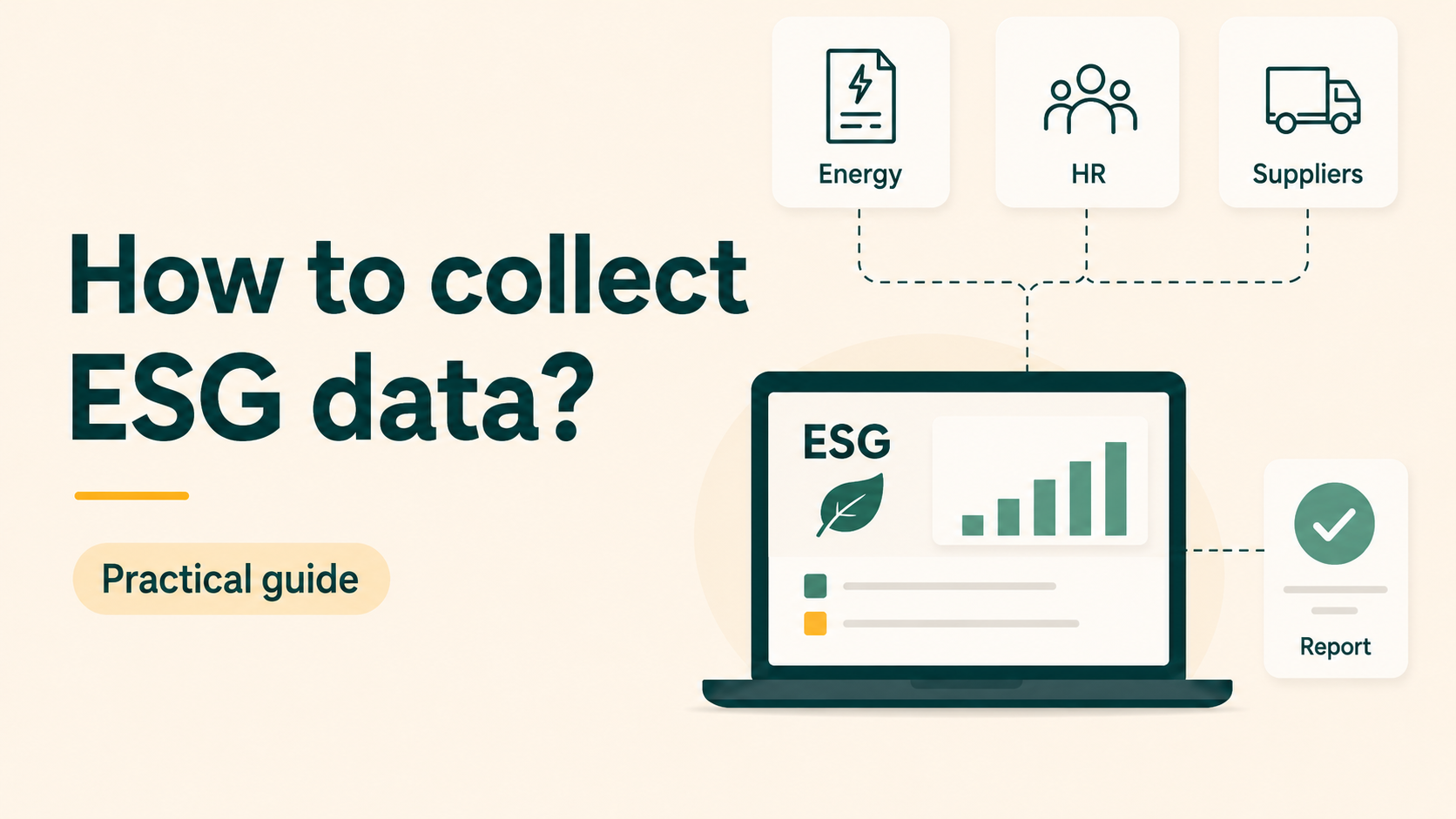
- Fragmented data sources. Energy data may sit in invoices or BMS systems, fleet data in leasing records, HR data in payroll systems, health and safety data in separate registers and supplier data in procurement.
- Lack of standardisation. One source uses kWh, another MWh, another only energy costs. Without common rules, conversions and assumptions quickly become a risk.
- Manual data entry. The most dangerous error is the one that looks credible: a shifted row, wrong month, overwritten file or value copied from an outdated version.
- Value chain data. Scope 3 emissions, supplier data, social risks and product information often sit outside the organisation, but the responsibility for the reporting process remains inside the company.
- Limited audit trail. ESG data must be supported by evidence: where the number came from, who approved it and what document confirms it.
Regulations may evolve, but the direction is clear: ESG data needs to be structured, verifiable and ready for reporting.
```What ESG Data Should Companies Collect?
```Before collecting ESG data, companies should clarify one important point: the goal is not to collect everything. ESRS reporting is based on double materiality, which means organisations identify topics that are material from both an impact and a financial perspective.
In practice, ESG data can be grouped into several key areas: environment, workforce, value chain, consumers, affected communities and business conduct.
E1 Climate Change
This includes Scope 1, Scope 2 and Scope 3 greenhouse gas emissions, energy consumption, decarbonisation targets and climate-related risks.
E2-E5 Environmental Topics
These areas cover water, waste, materials, pollution, biodiversity and circular economy data.
S1-S4 Social Topics
This includes workforce data, health and safety, training, supplier-related social risks, affected communities, consumers and end-users.
G1 and ESRS 2 Governance
Governance data covers ethics, policies, controls, whistleblowing, anti-corruption, management responsibilities, risks and the reporting process itself.
Governance should not be treated as a small table at the end of the report. Under ESRS, many governance, strategy and control-related disclosures are part of cross-cutting ESRS 2 requirements.
```CSRD in Practice: ESG Data That Keeps Coming Back
```Companies may follow regulatory updates, simplifications and implementation timelines, but several ESG data areas consistently remain important in practice.
- GHG emissions: Scope 1, Scope 2 and an increasingly mature approach to Scope 3.
- Energy and energy carriers: electricity, fuels, heating, cooling and other energy sources.
- Health and safety: incidents, accidents, absenteeism, training and basic workforce indicators.
- Supply chain: supplier questionnaires, audits, ESG risks and corrective actions.
- Business conduct: policies, controls, procedures, whistleblowing and anti-corruption.
- Audit trail: source documents, approval status, responsible persons and data history.
Digital reporting and data tagging are also becoming increasingly important. ESG data should be comparable, machine-readable and ready for internal and external review.
```5 Steps to Organise ESG Data Collection
```There is no shortcut here. Effective ESG data collection requires a clear operating model, defined roles and repeatable processes. Not glamorous, unfortunately. Useful, though.
1. Map Your ESG Data Sources
Start by identifying which indicators are material, where the data is created, who owns each source and how often it can be updated.
Typical ESG data sources include:
- utility invoices and meter readings,
- ERP and accounting systems,
- HR and payroll systems,
- procurement and supplier databases,
- fleet and logistics records,
- health and safety registers,
- internal policies and governance documentation.
2. Assign Data Owners
Every ESG data point should have clear ownership. Without responsibility, the process quickly disappears into email threads, spreadsheet versions and polite confusion.
Useful roles include:
- Data Owner: responsible for the source and business meaning of the data.
- Data Steward: responsible for preparing and updating the data.
- Approver: responsible for reviewing and approving the data.
- ESG Lead: responsible for coordinating the overall ESG reporting process.
3. Standardise Formats and Definitions
ESG data must be collected in consistent formats. This includes units, reporting periods, locations, rounding rules, calculation methods and source descriptions.
Companies should define:
- approved units of measurement,
- conversion factors,
- reporting periods,
- location and entity structures,
- data quality rules,
- source documentation requirements.
4. Automate Data Collection Where Possible
Automation can significantly reduce manual work and improve data quality. The biggest gains often come from invoice imports, ERP and HR integrations, supplier questionnaires, automated reminders and approval workflows.
Automation helps teams avoid repeated manual data entry, reduce errors and maintain a clear history of changes.
5. Validate and Control Data Quality
Validation is where ESG data becomes usable. Companies should check completeness, units, ranges, consistency and supporting evidence.
Useful validation checks include:
- missing values,
- unusual changes compared with previous periods,
- incorrect units,
- duplicate entries,
- missing source documents,
- unapproved data,
- inconsistent calculations.
Supporting evidence may include invoices, reports, protocols, system exports, supplier declarations and approval logs.
```Common ESG Data Collection Mistakes
```Missing Scope 3 Supplier Data
Scope 3 data is often the most difficult to collect because it depends on suppliers, logistics partners and value chain information. Start with the largest procurement categories, introduce supplier questionnaires, use proxy data where necessary and build a plan to improve data quality over time.
Inconsistent Units of Measurement
Gas in cubic metres, energy in kWh, waste in tonnes and kilograms. Without a unit dictionary and validation rules, reporting becomes messy very quickly. Standardised units and conversion rules should be defined before the data collection cycle starts.
Collecting Data Only Once a Year
A once-a-year ESG data collection process usually leads to missing sources, weak evidence and last-minute corrections. Monthly or quarterly cycles work much better, especially for data such as energy, water, waste, fleet and health and safety indicators.
Indicators Without Sources
A number in a table is not enough. During review or assurance, companies need to show where the value came from, who approved it and what evidence supports it.
No Clear Approval Workflow
ESG data should not move directly from a spreadsheet into a report. It needs review, approval and a visible status. This is especially important when data is collected from multiple departments or sites.
```ESG Data Collection Tools: What to Look For
```If your company is considering an ESG data management tool, do not focus only on dashboards. Dashboards look nice, but the real value is in process control, data quality and audit readiness.
A good ESG data collection tool should support:
- data imports from CSV, Excel, API, ERP and HR systems,
- approval workflows,
- audit trail and change history,
- attachments and source evidence,
- unit, range and completeness validation,
- supplier data collection,
- role-based access,
- export for reports, management and auditors.
The goal is not only to collect ESG data faster. The goal is to make the data reliable, traceable and ready for reporting.
```How Envirly Supports ESG Data Collection
```Envirly helps companies move from fragmented ESG data sources to a controlled, repeatable and audit-ready reporting process.
With Envirly, organisations can manage:
- ESG data source mapping,
- data ownership and responsibilities,
- automated workflows,
- data validation,
- supporting evidence,
- audit trail,
- supplier data collection,
- reporting outputs for internal and external stakeholders.
Instead of relying on scattered spreadsheets and email reminders, companies can build a structured ESG data process that supports CSRD and ESRS reporting requirements.
Let’s talk about your ESG data process.
```FAQ
```How should a company start collecting ESG data?
Start with a map of ESG data sources and data owners. First define the indicators, then identify the sources, responsibilities and collection cycle: data submission, validation and approval.
How often should ESG data be collected?
For most indicators, quarterly collection is a good minimum. Monthly collection is recommended where data is generated regularly, such as energy, water, waste, fleet or health and safety data.
How can ESG data be prepared for audit or assurance?
Introduce audit trail, source evidence, version history and formal approval workflows. Each material number should have a clear source, an approval status and supporting documentation.
What are the most common ESG data sources?
Common sources include invoices, meter readings, ERP systems, HR systems, procurement data, supplier questionnaires, fleet records, health and safety registers and internal governance documents.
Why is ESG data quality important?
ESG data quality is essential because the data must support reporting, decision-making, audit readiness and regulatory compliance. Poor-quality data creates reporting risk and weakens trust in the final ESG report.
```



.png)



-p-500.png)


.png)


