← Back to articlesVSME Report: How to Prepare Your Company for Voluntary ESG Reporting and Use It with Clients and Banks in 2026
VSME, the Voluntary Sustainability Reporting Standard for SMEs, is a voluntary European Commission standard designed to harmonise the scope of ESG data that small and medium-sized enterprises provide to clients and financial institutions. It helps companies respond to recurring questionnaires with one consistent report instead of ten slightly different versions of the same thing, because apparently civilisation needed a standard for not asking the same question in twelve spreadsheets.
1. Where VSME came from and why SMEs receive ESG requests
If you work with large companies, sooner or later you will receive an ESG questionnaire. This is the result of the so-called trickle-down effect: organisations subject to mandatory reporting, including CSRD, collect data not only about themselves but also from suppliers and subcontractors. The problem is that, for years, everyone has been asking for largely the same information, only in a different file and a different format.
The European Commission therefore adopted Recommendation (EU) 2025/1710, proposing a common standard for non-listed SMEs and micro-enterprises and encouraging large companies and financial institutions to limit their ESG data requests to the VSME scope.
2. What VSME is and its status under EU Recommendation 2025/1710
VSME, the Voluntary Sustainability Reporting Standard for SMEs, is a voluntary sustainability reporting standard for non-listed micro, small and medium-sized enterprises. The standard was developed by EFRAG and adopted by the European Commission in the form of a recommendation.
This distinction matters: a recommendation is not a legal obligation, but it creates a market reference point. In practice, many companies will expect data “in the VSME standard”, because it is the simplest way to compare suppliers and reduce questionnaire chaos.
3. How the VSME report is structured: Basic and Comprehensive modules
VSME is modular. A company can report under the Basic module or under the Basic plus Comprehensive modules. The Comprehensive module always builds on Basic, so if you plan to go further, the starting point is still the foundation.
In short:
- Option A: a VSME report under the Basic module, covering B1-B11.
- Option B: a VSME report under the Basic plus Comprehensive modules, covering B1-B11 and C1-C9.
- The “if applicable” principle: some disclosures are reported only if they are relevant to your business activities, not simply because the data happens to be missing.
- For micro-enterprises: Basic is described as a “target approach”, meaning micro-enterprises do not have to apply the full Basic module and may use selected parts.
4. VSME disclosure checklist: B1-B11 and C1-C9, plus data sources
Below is a practical checklist to help you get started with VSME. It does not replace Annex I, but it helps organise where the data typically comes from and who owns it inside the company.
Basic module, B1-B11: the minimum usually sufficient for B2B relationships
| Disclosure | What it covers | Typical data sources | Owner in the company |
|---|
| B1 | Basis for preparing the report, company information and reporting period | Company register data, NACE code, organisational structure, reporting period | Finance / Management Board |
| B2 | Practices, policies and planned initiatives across environmental, social and governance topics | Policies, procedures, targets, action plans | Management Board / ESG / HR / Operations |
| B3 | Energy and GHG emissions, usually Scope 1 and 2 | Energy invoices, fuel records, fleet data, meters, emission factors | Operations / Finance / ESG |
| B4 | Pollution of air, water and soil, if applicable | Permits, measurements, environmental reports | EHS / Operations |
| B5 | Biodiversity, if applicable | Locations, sensitive areas, environmental decisions | EHS / Operations |
| B6 | Water, if applicable | Invoices, meter readings, process monitoring | Operations |
| B7 | Resources and waste, including circularity, if applicable | Waste records, transfer notes, supplier and waste-management contracts | Operations |
| B8 | Workforce: basic employee data | HR system, FTE records, employment contracts | HR |
| B9 | Health and safety at work | Accident registers, preventive actions, health and safety training | H&S / HR |
| B10 | Remuneration, collective agreements, training and development | HR policies, training data, information on social dialogue | HR |
| B11 | Convictions and fines for corruption and bribery, if any occurred | Compliance records, legal files, case registers | Compliance / Legal |
In practice, B3, meaning energy and emissions, is usually the area that needs the most data clean-up. If you need to calculate your company’s carbon footprint quickly, the Envirly calculator may help:
Envirly Carbon Footprint Calculator
Comprehensive module, C1-C9: when a bank or client expects more
The Comprehensive module is an extension that appears more often in relationships with financial institutions and the most demanding customers. Companies usually move into this module when questions arise about strategy, emission-reduction targets, climate risks or human-rights processes.
- C1 - Strategy, business model and sustainability-related initiatives
- C2 - Expanded description of practices, policies and initiatives for the transition towards a more sustainable economy
- C3 - GHG emission-reduction targets and climate transition plan, if the company has adopted them
- C4 - Climate risks, if applicable
- C5 - Additional workforce characteristics
- C6 - Policies and processes related to human rights
- C7 - Severe negative human-rights incidents, if any occurred
- C8 - Revenues from selected sectors and references to benchmarks
- C9 - Gender diversity ratio in governance bodies
For more difficult disclosures, including C2, C3 and C7, EFRAG has published supporting guides.
5. How to prepare a VSME report step by step
Choose the reporting variant: Basic or Basic plus Comprehensive
Start with who is asking for the data. If the goal is a quick response to a client in the supply chain, Basic is usually enough. If a bank asks about strategy, emission-reduction targets and risks, consider the Comprehensive module.
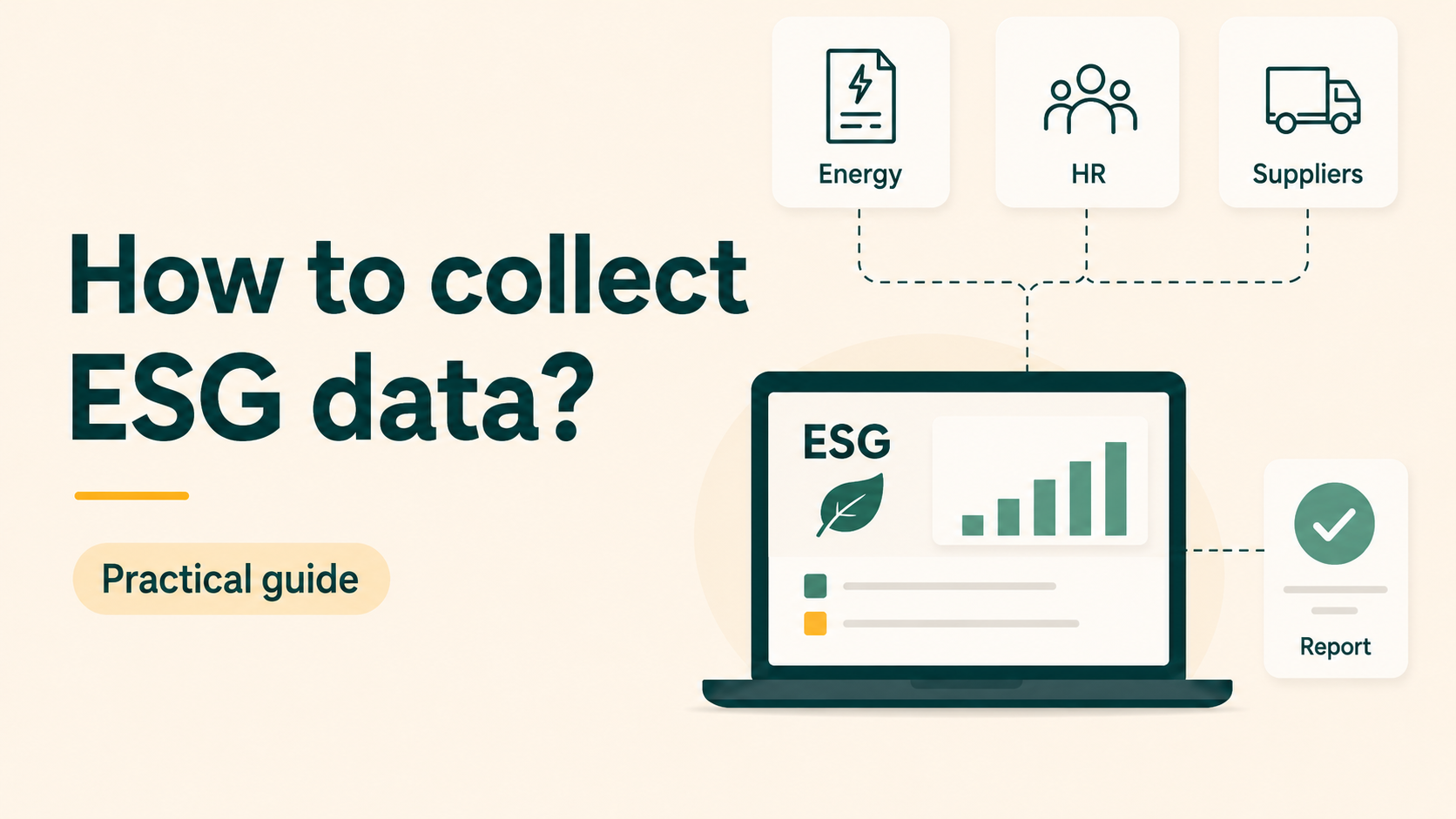
Map your data: who owns it, where it comes from and how often it is updated
VSME touches several departments at once: finance for basic data and invoices, operations for energy, water and waste, HR and health and safety, and compliance. It is worth assigning data owners and agreeing the collection format from the start.
Prioritise B3: energy and emissions
This is the most transactional part of the report and the one most often requested by clients and banks. Make sure the reporting period is consistent and that the calculation method is clearly described.
Build an evidence pack
The report should work in real business relationships. Prepare a set of files and references that confirm key figures and policies, such as health and safety procedures, waste records or an anti-corruption policy.
Write the report and check the “if applicable” principle
If you mark something as “not applicable”, it should be because it genuinely does not apply to your business profile. If in doubt, check Annex II, which provides practical guidance without adding new requirements.
Publish and update the report regularly
The greatest value of VSME appears when the report can be refreshed every year without rebuilding the process from scratch.
If your company already reports under ESRS/CSRD, or is preparing to do so, these Envirly resources may also be helpful:
6. How to use VSME with clients, banks and across the supply chain
VSME is mainly designed to close the ESG-questionnaire loop. Instead of answering every counterparty in a different file, you provide one report and, where needed, map their questions to specific VSME disclosures, either B or C.
1. A standard response to an ESG questionnaire
A good practice is to attach a short email note and a mapping table linking the counterparty’s questions to VSME disclosures, such as emissions to B3, health and safety to B9, or anti-corruption to B11.
2. An argument for reducing the scope of data requests
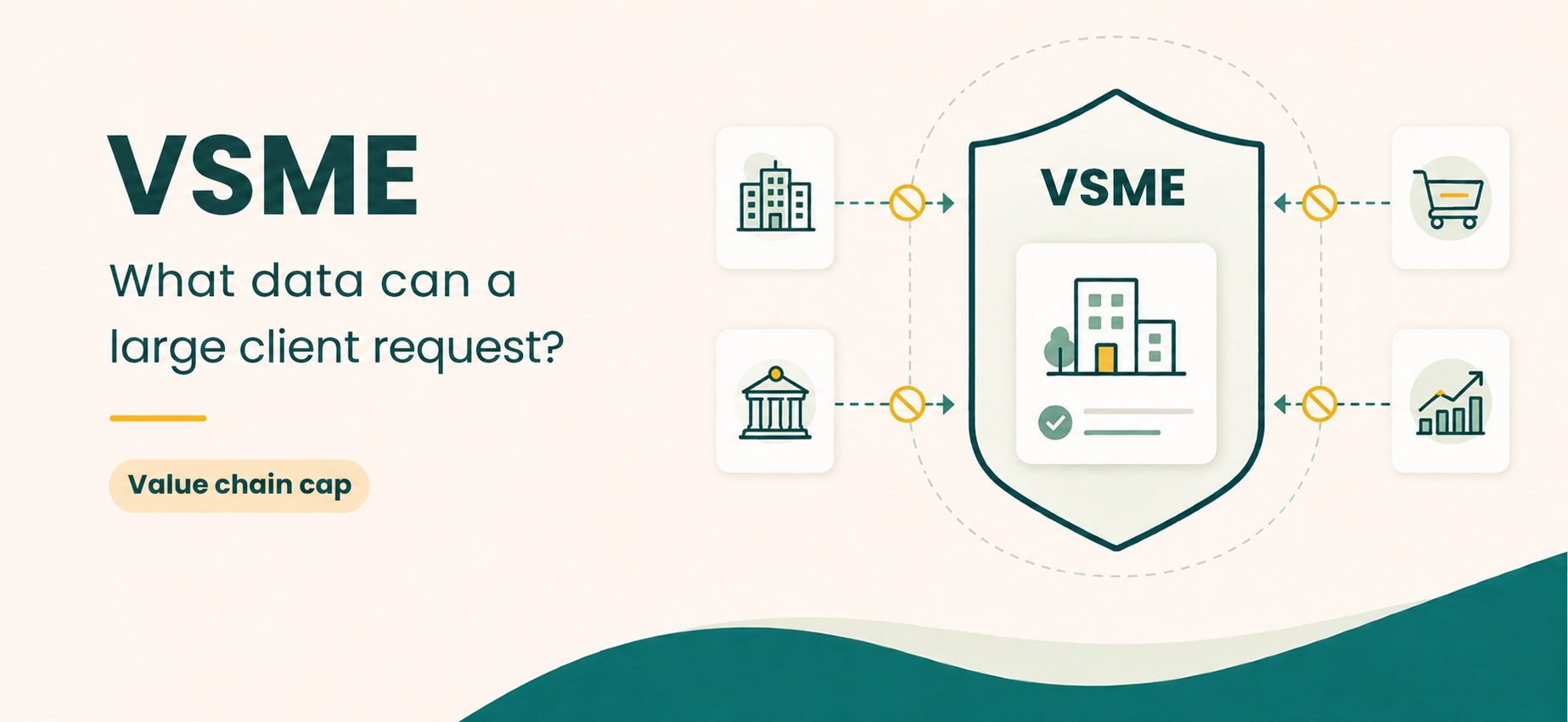
The European Commission recommendation states that financial institutions and other data users should, when they need ESG information from SMEs, limit their requests to the VSME scope as far as possible. This is worth quoting directly when speaking with clients.
3. VSME as a foundation for other requirements, including EcoVadis
Many supplier-assessment processes rely on similar data and documents. Once you organise policies, indicators and evidence under VSME, it becomes easier to respond to further requests, including ratings.
7. Common mistakes and good practices
Confusing “not applicable” with “we do not have the data”
The “if applicable” principle works when the company assesses whether a topic is relevant to its business profile. Missing data is a signal to improve the process, not to delete the disclosure.
Inconsistent periods and units
The easiest way to lose credibility is to report energy from one year, employment from another, and then provide no explanation of the method.
Policies on paper with no implementation
B2 and C2 are not a paperwork competition. If you declare a practice, you should have evidence of action: accountability, training, procedures and monitoring.
Moving into Comprehensive before Basic is stable
The Comprehensive module makes sense only when Basic is organised, repeatable and reliable.
8. Downloads and official sources
If you want to implement VSME without guessing, three things are essential: Annex I, meaning the standard itself; Annex II, meaning practical explanations; and the European Commission Q&A, which explains, among other things, the relationship between VSME, the Omnibus package and the “value chain cap” approach.
In addition, EFRAG is developing a broader tooling ecosystem, including a digital template in Excel and an XBRL taxonomy.
9. How Envirly can help
If you want VSME to become a process rather than a one-off scramble, the most important step is to organise data sources, responsibilities and recurring updates. At Envirly, we combine advisory support with tools for ESG data collection and emissions calculation.
Official sources and materials
Prepare your VSME report without turning it into a spreadsheet excavation site
Envirly helps companies organise ESG data, calculate emissions and turn sustainability reporting into a repeatable process that can support client relationships, bank discussions and supply-chain requirements.
Learn more about ESG reporting in Envirly



.png)



-p-500.png)


.png)


